

Source: Wikimedia

Was the Confederacy a New Nation?
History records that Jefferson Davis was the first president of the Confederate States of America. But there was one man who never conceded to Davis the dignity of that title. That man was Abraham Lincoln.
During the entire four years of the Civil War, the words “President Davis” never once escaped the lips of the President of the United States, and that fact was a fundamental element of the strategy that ensured there would never be a second president of the Confederacy.
The Confederate States of America
By the time Abraham Lincoln was inaugurated as President of the United States on March 4, 1861, the Confederate States of America had already considered itself a going concern as a separate and independent nation. A provisional constitution was unanimously ratified on February 8, 1861, and on February 18, 1861, Jefferson Davis was sworn in as chief executive of the aspiring new nation. In his inaugural address, Davis spoke forcefully of “the separate existence and independence we have asserted.” He went on to say, “We have entered upon the career of independence, and it must be inflexibly pursued.” Davis maintained his inflexible view that the Confederate States constituted a new nation entirely separate from the United States until the day he died.

Source: Library of Congress via Wikimedia (Public Domain)

To Lincoln Secession Was a Constitutional Impossibility
But that view of the Confederacy as the legitimate national government over states that had seceded from the Union was one that Abraham Lincoln was equally inflexible in denying. In his own inaugural address, the new president, lawyer that he was, presented what amounted to a legal brief justifying his conviction that “the Union of these States is perpetual.” To his mind secession was inherently unconstitutional because, “It is safe to assert that no government proper ever had a provision in its organic law for its own termination.” Lincoln made it clear that the Union would fight, if necessary, to maintain its own integrity, saying that it was “the declared purpose of the Union that it will constitutionally defend and maintain itself.”
Finally, as he closed his speech, the new President spoke directly to the people of the seceded Southern states. “In your hands, my dissatisfied fellow-countrymen, and not in mine,” he said, “is the momentous issue of civil war.”
That sentence epitomizes Abraham Lincoln’s entire approach to the issue of secession. He considered it a constitutional impossibility, and would never, by word, action, or implication, officially concede that it had been successfully accomplished. That’s why, when he directly addressed citizens of the states that three weeks before had installed Jefferson Davis as president of what they claimed to be a separate nation, Lincoln still spoke of them as “my dissatisfied fellow-countrymen.”

Source: flickr/moosevlt
For Lincoln the Confederacy Was Not a Nation – Except When It Was
In theology, the concepts of orthodoxy and orthopraxy are closely related. Orthodoxy relates to correct belief, while orthopraxy has to do with correct action. Ideally, belief and action should be in perfect alignment. But, as many who attempt to put their faith into practice have experienced, it is sometimes difficult to ensure that your course of action always conforms to your sincerely held beliefs.
Very soon after the start of the Civil War, Abraham Lincoln found himself caught between the constitutional orthodoxy that “the Union of these States is perpetual,” and the apparent inconsistencies required to practically apply that concept in the context of a fraternal conflict.
If, as Lincoln unwaveringly maintained, the people of the Southern states were still part of the Union, then any of them who took up arms against the US government were by definition guilty of treason. When such people were captured, whether on the battlefield or otherwise, they were legally liable to the penalty of death. But, precisely because he still considered them to be US citizens, it was impossible for Lincoln to treat the tens of thousands of Southerners who flocked to enlist in Confederate military service simply as traitors to be tried and executed.
In his proclamation asking the states to bring out 75,000 militiamen to put down the rebellion, Lincoln acknowledged that the Confederate armies constituted “combinations too powerful to be suppressed by the ordinary course of judicial proceedings.” In other words, it was simply not practical to deal with all the individuals in arms for the Confederacy as mere criminals. Moreover, unlike even the largest of normal criminal conspiracies, the size of the Confederate forces gave them the power of effective retaliation for any penalties exacted upon their soldiers. When Lincoln considered treating the crews of rebel privateers that captured or destroyed Union merchant ships as pirates, subject under international law to be hung, Confederate threats to hang captured Union officers in retaliation caused him to drop the idea.
A similar paradox arose when Lincoln decided to institute a naval blockade of Southern ports to deny the South the ability to import arms and other products from Europe. According to international law, a blockade could only be employed between warring nations, and not by a single nation against its own people. But understanding that the blockade was a powerful and indeed necessary strategic weapon in winning the war, Lincoln unabashedly imposed it while still refusing absolutely to acknowledge the nationhood of the Confederacy.
Lincoln Snubs Jefferson Davis Again and Again
In a number of ways Abraham Lincoln found it necessary, on a practical level, to deal with the Confederacy as though it was a separate nation. But one thing he never compromised was his insistence that no such government as the Confederate States of America existed.
That’s why when Jefferson Davis, prior to the onset of hostilities, sent a letter to President Lincoln asking him to receive envoys appointed by Davis “For the purpose of establishing friendly relations between the Confederate States and the United States,” Lincoln refused to receive the envoys or even to acknowledge the letter.
That was just the first of several snubs the US president delivered to the man whose pretensions as president of a supposedly sovereign Confederate nation he never accepted. By June of 1864 Davis was driven to complain in a letter to North Carolina Governor Zebulon Vance:
We have made three distinct efforts to communicate with the authorities at Washington, and have been invariably unsuccessful… No answer has ever been received… a few months ago, a gentleman was sent whose position, character and reputation were such as to insure his reception, if the enemy were not determined to receive no proposals whatever from the (Confederate) Government…
The final sentence in this paragraph shows that Jefferson Davis fully understood the message Abraham Lincoln was sending him. Davis said,
To attempt again (in the face of these repeated rejections of all conference with us) to send commissioners or agents to propose peace, is to invite insult and contumely, and to subject ourselves to indignity without the slightest chance of being listened to.
That was it in a nutshell. As Davis realized, nothing he said to the United States government, or Abraham Lincoln, in his capacity as president of the Confederate States would have “the slightest chance of being listened to.”

Source: Mathew Brady via Wikimedia (Public Domain)

Davis Tries to Find Ways to Get Lincoln to Acknowledge Him
Davis apparently fully understood this reality almost from the beginning of the conflict. In July of 1863 he authorized Confederate Vice President Alexander Stephens (the gentleman of position, character and reputation mentioned in the Vance letter) to attempt to go to Washington under a flag of truce to meet with President Lincoln. The purpose was to negotiate a more humane system for the treatment of prisoners of war.
Perfectly aware that Lincoln would take no notice of any communication from him in his role as Confederate president, Davis provided Stephens with two almost identical letters addressed to Lincoln. The first was signed by Davis “as Commander-in-Chief of the land and naval forces now waging war against the United States,” and was addressed to Lincoln as Commander-in-Chief of the US forces. Stephens was instructed that if Lincoln refused to receive that letter because it did not address him as President of the United States, Stephens was to give him the second letter, which differed from the first only in being signed by Davis as CSA president, and addressed to Lincoln as US president.
In the end, Lincoln would accept neither version of the letter, nor Stephens himself. Never allowed to cross Union lines, all Stephens got for his efforts was a curt and barely polite note signed by Gideon Welles, Secretary of the Navy, saying that “The customary agents and channels are adequate for all needful military communications and conferences between the United States and the insurgents.”
To Lincoln, Jefferson Davis Was Nothing More Than a Leader of Insurgents
That word “insurgents” became Lincoln’s characteristic official term for all members of the Confederate military and government. That applied especially to Jefferson Davis.
For example, in his annual address to a joint session of Congress in December of 1864, President Lincoln made direct reference to Jefferson Davis in a speech for the first time. But, as in every other public statement he made during the war, Lincoln never mentioned Davis by name, and certainly not by his title as Confederate president. Wanting the nation to understand that there was no chance of productive peace negotiations with Davis, Lincoln told the Congress,
It seems to me that no attempt at negotiation with the insurgent leader could result in any good. He would accept nothing short of severance of the Union- precisely what we will not and cannot give. His declarations to this effect are explicit and oft- repeated. He does not attempt to deceive us. He affords us no excuse to deceive ourselves. He cannot voluntarily reaccept the Union; we cannot voluntarily yield it. Between him and us the issue is distinct, simple, and inflexible. It is an issue which can only be tried by war and decided by victory. If we yield, we are beaten; if the Southern people fail him, he is beaten.
“Insurgent leader.” That was the only title Abraham Lincoln would ever apply to Jefferson Davis.
Jefferson Davis’s farewell Senate speech justifying secession
Lincoln Was Willing to Negotiate With Davis Only as the Rebel Military Leader
Lincoln freely acknowledged that Davis was the leader who controlled the Confederate armies. That was a matter of undeniable fact, and Lincoln had no problem addressing Davis on that basis. For example, in a famous July 1864 letter addressed “To Whom It May Concern,” Lincoln affirmed that:
“Any proposition which embraces the restoration of peace, the integrity of the whole Union and the abandonment of slavery, and which comes by and with an authority that can control the armies now at war against the United States, will be received and considered by the Executive Government of the United States.”
That “authority that can control the armies now at war against the United States” was, of course, Jefferson Davis.
When Francis Preston Blair, Sr., patriarch of a prominent political family allied with Lincoln, initiated a self-appointed “shuttle diplomacy” mission between Richmond and Washington in an attempt to negotiate a termination of the war, Lincoln gave him a note to be shown to Davis setting forth the terms under which Lincoln was willing to open negotiations. But the note was addressed not directly to Davis, but to Blair, authorizing him to “say to him (Davis) that I have constantly been, am now, and shall continue, ready to receive any agent whom he, or any other influential person now resisting the national authority, may informally send to me, with the view of securing peace to the people of our one common country.”
There it was, again. Even when communicating semi-directly with the Confederate president, Lincoln was extremely careful to never communicate acceptance, even implicitly, of the legitimacy of Davis’s position. To Lincoln, Jefferson Davis was no president, but only an “influential person now resisting the national authority.”
Lincoln Finally Meets With a Delegation Sent by Davis
Blair’s initiative did not bring about peace. But it did lead to a meeting between Lincoln and representatives sent by Davis in an attempt to find some common ground for negotiation. Vice President Alexander Stephens led a team of three Confederate commissioners who met with Lincoln and Secretary of State William H. Seward at Hampton Roads, Virginia. Lincoln received them not as officials of the Confederate government, but as “influential persons” who represented another “influential person” back in Richmond, Jefferson Davis.
This “Hampton Roads Peace Conference,” held on February 3, 1865, bore no fruit. The insuperable obstacle was Jefferson Davis’s insistence that he would negotiate only “for the purpose of securing peace to the two countries,” while Lincoln was adamant that the basis of negotiation could only be “securing peace to the people of our one common country” (emphasis added).

Source: Wikimedia Commons
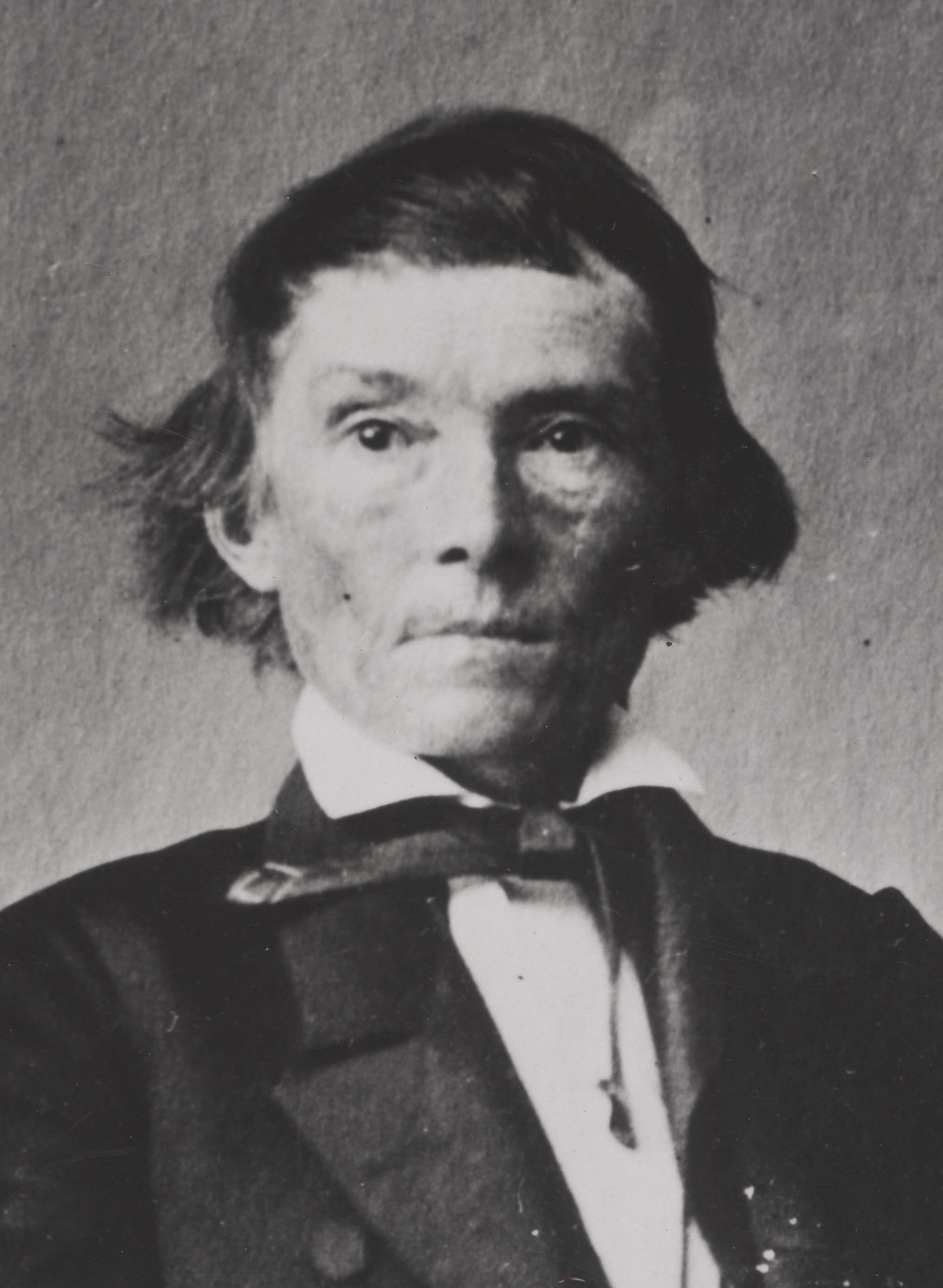
The meeting was a cordial one, even punctuated by a few laughs. Lincoln and Stephens had known one another before the war, and spoke as friends. But the president made very clear that he viewed the Confederates simply as Americans who had unlawfully taken up arms against their rightful government.
When he later reported on the conference to his Cabinet, President Lincoln quoted one of the Southern delegates as stating, “Well, according to your view of the case we are all guilty of treason, and liable to be hanged.”
After a brief pause, Mr. Lincoln replied, “Yes, that is so.”
“Well,” the Southerner continued, “we suppose that would necessarily be your view of our case, but we never had much fear of being hanged while you were President.”
Interior Secretary John Palmer Usher recalled that from the President’s manner as he recounted this episode, it was clear that Lincoln considered the Confederates’ confidence that he wouldn’t hang them a compliment.
One Nation or Two? An Irreconcilable Difference
In their report to Davis, subsequently published in both Southern and Northern newspapers, the Confederate commissioners said:
“(T)he enemy refused to enter into negotiations with the Confederate States, or any one of them separately… We understood from him that no terms or proposals of any treaty or agreement, looking to an ultimate settlement, would be entertained or made by him with the authorities of the Confederate States, because that would be a recognition of their existence as a separate Power, which under no circumstances would be done.”
Lincoln’s Refusal to Respect Jefferson Davis Was a Strategic Necessity
Abraham Lincoln would never give to Jefferson Davis any respect or recognition as a true head of state, not because of any personal animosity or disdain, but because to do so would be to implicitly recognize the nationhood of the Confederacy. And to do that would be to concede the very issue on which the war was being fought.
This, for Abraham Lincoln, was the ground on which he took his stand from the beginning to the end of the Civil War. He believed, and more importantly, was able to convince the American people to believe, that throughout four years of bloody conflict the rebellious Southerners remained “dissatisfied fellow-countrymen,” and not alien residents of a foreign country.
The Power of Lincoln’s Idea
It was that idea that drew Northern men in their hundreds of thousands to volunteer for military service, putting their lives on the line to preserve the Union.
It was because of that idea that Northerners, soldiers and civilians as well, gained strength to continue to support President Lincoln through all the devastating Union military setbacks that seemed to occur on a regular basis throughout much of the war. They saw themselves as patriotically fighting for the survival of the nation, North and South, rather than as invaders attempting to conquer another country.
And it was that idea that shaped Northerners’ attitude toward their former enemies when the fighting was over. After Robert E. Lee surrendered the most important Confederate army to Ulysses S. Grant at Appomattox, virtually ending the war, General Grant took steps to insure that his own army’s celebrations of victory did not unnecessarily humiliate the devastated Southern soldiers.“The war is over,” he said, “the rebels are again our countrymen.” (Of course, to Lincoln, they had never ceased being “our countrymen”).
And finally, Abraham Lincoln’s unwavering commitment to the belief that all Americans, North and South, remained citizens of a single, united nation came to be shared even by former rebels.
Sam Watkins was a soldier who served in Confederate armies from the beginning of the conflict in 1861 until the war ended in 1865.

Source: Wikimedia (Public Domain)

In his post-war memoir, Company Aytch, Watkins expresses Lincoln’s idea in his own way:
“America has no north, no south, no east, no west. The sun rises over the hills and sets over the mountains, the compass just points up and down, and we can laugh now at the absurd notion of there being a north and a south. We are one and undivided.”
In the end, it was not only Abraham Lincoln’s armies that prevailed, but his unwavering belief that the United States of America, North and South, was and would forever be, “one nation under God, indivisible, with liberty and justice for all.”
© 2013 Ronald E. Franklin